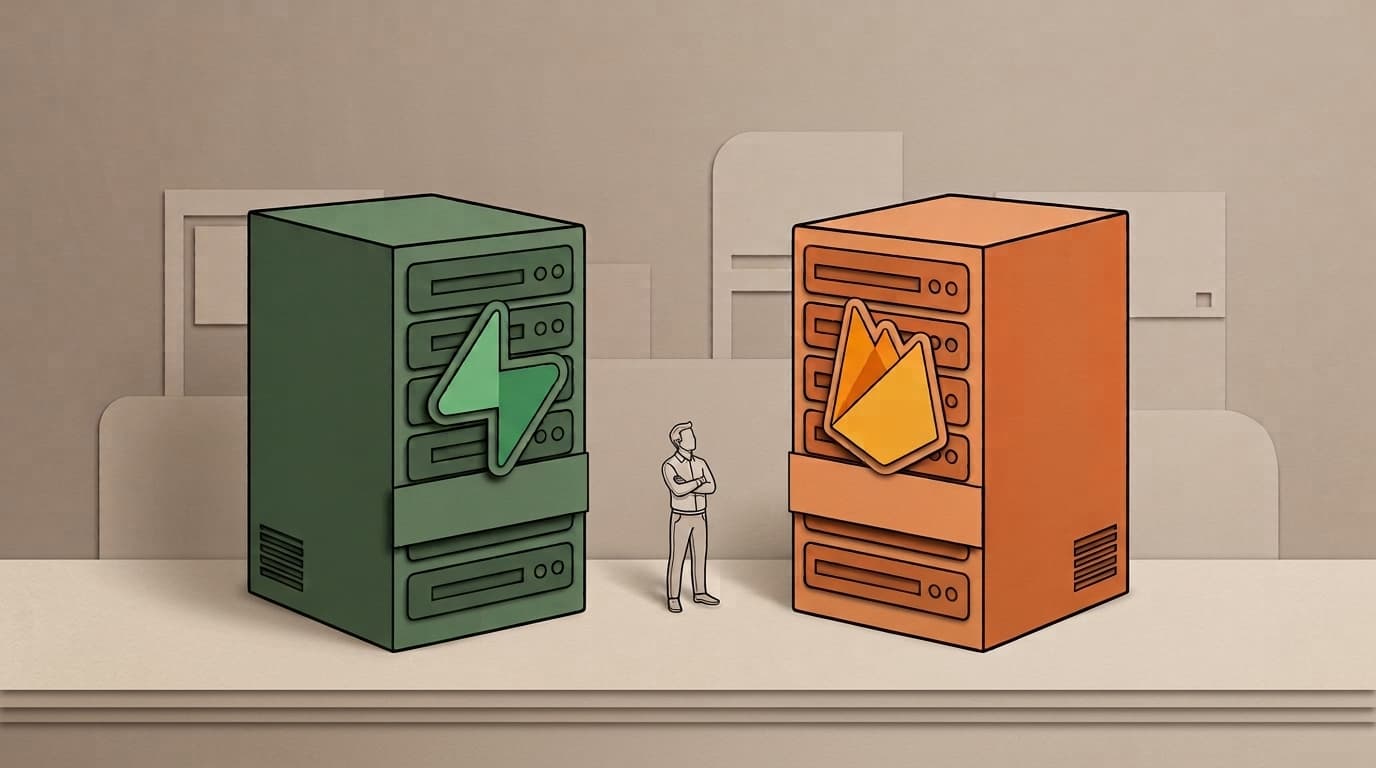
If you have started a side project in the last two years, you have probably had this exact debate with yourself. Supabase or Firebase? Both promise to get you from zero to a working backend in minutes. Both have auth, storage, and a database out of the box. But they are built on completely different philosophies, and that matters more than the feature comparison tables suggest.
The Core Difference
Firebase is Google's fully managed, proprietary NoSQL platform. Your data lives in Firestore, a document database, and you query it with their SDK. It works great until it does not, and when it does not, you are usually looking at a data model problem that is expensive to fix.
Supabase is built on Postgres. Real SQL. Real joins. Real indexes. It is open source, which means you can self-host it if Google ever decides to shut Firebase down the way they shut down everything else. That is not a small thing to consider.
Database
Firebase uses Firestore, a NoSQL document store. It is fast for simple reads, and its real-time listeners are genuinely good. But the query model is limited. No joins, no aggregations, no full-text search without adding Algolia or Typesense on top.
Supabase gives you Postgres. You write SQL. You can do joins, views, stored procedures, and full-text search with pg_vector for AI features. If you know SQL, you already know how to use it. If you do not know SQL, this is a good reason to learn it.
Auth
Firebase Auth is excellent and battle-tested. Google login, Apple login, phone auth, anonymous auth, all of it works reliably and the SDK handles token refresh automatically.
Supabase Auth has caught up significantly. It supports OAuth providers, magic links, phone OTP, and row-level security that ties directly into your database permissions. The RLS system is more powerful but also more complex to set up correctly.
Real-Time
This is where Firebase still has an edge. Firestore's real-time subscriptions are deeply integrated and work well even on unreliable connections. It was built for real-time from day one.
Supabase real-time is built on Postgres logical replication and works well for most use cases. It is good enough for chat, notifications, and live dashboards. If you are building something that needs real-time at Figma's scale, Firebase might still be the better starting point.
Pricing
Firebase pricing is read-based for Firestore, which can surprise you at scale. Heavy read workloads get expensive fast, and optimizing your data model to reduce reads adds complexity that defeats the point of using a simple backend.
Supabase's free tier is generous and their paid plans are predictable. Compute-based pricing is easier to reason about for most apps than per-read pricing.
Which One to Pick
Pick Firebase if you are building a mobile-first app that needs bulletproof real-time, you want Google's infrastructure with zero ops overhead, and your data model is document-shaped from the start.
Pick Supabase if you want a real relational database, you care about being able to self-host or switch providers later, you are building with Next.js or any server-side framework, or you want to use SQL and not relearn a proprietary query model.
For most web apps built in 2026, Supabase is the better default. The Postgres foundation gives you flexibility that NoSQL takes away, and you will hit the ceiling of a document model faster than you expect.